
One agency owner let an AI agent reply to a prospect before he had read it. Another watched an AI video tool burn through his team's credits in a few hours and produce nothing usable. A third caught his agent writing a claim on a client's website that the client had never made.
All three still run AI every day. They stopped trusting it with the last step.
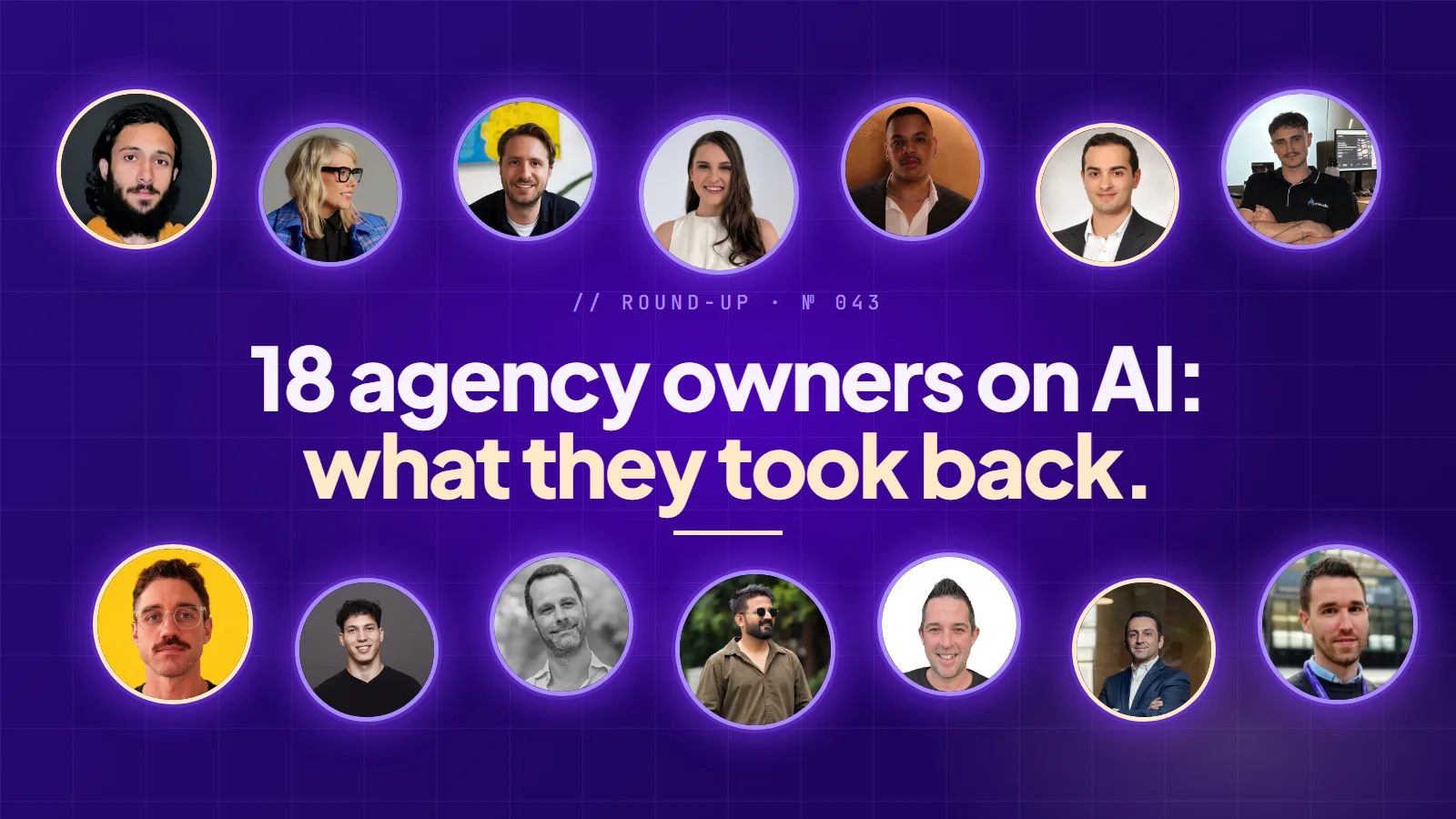
They are three of the 18 agency owners who told us what they handed to AI this year, and what they took back. Most of them found the line by crossing it first. Every agency owner we work with at Apptimistic is somewhere on this curve, with a few agents running and a short private list of near misses.
We wanted to hear from owners doing the work, so we put a call-out on SourceBottle and asked agency founders two things. Name one workflow you handed to AI this year, and one task you took back. Answers came from PR firms, SEO shops, a 15-person branding studio in Melbourne, a growth agency in Oxford and a one-person AI visibility agency in Miami.
Eleven owners gave a weekly hours-saved figure, from 3 hours up to 25. Two refused to give one because they never timed the work before they changed it. Twelve now make a person approve anything AI writes before a client, prospect or journalist sees it.
Below you will find what they automated, what they pulled back and why, and seven rules for starting your own. Every quote is in the owner's own words, trimmed for length.
What they handed to AI
Most of what moved to AI this year happens before anyone talks to a client. Research, monitoring, reporting and agency admin made up nearly every answer.
Research and monitoring
If you automate one thing first, make it the research you do before a pitch or a meeting. The volume is high, the task repeats daily, and a bad result gets caught before a client sees it.
“The agent now monitors selected news sources, filters out irrelevant stories, matches genuine opportunities to the appropriate client and spokesperson, and sends the source, context, suggested angle and a draft pitch to Slack. A publicist then approves, edits or rejects it. The agent never contacts the journalist or client directly. Across 10 client accounts, it saves us approximately 20 hours each week.”
Automated news monitoring and pitch drafts · Took back journalist follow-ups · Saves about 20 hours a week
Maria's team used to spend the first hour of every day scanning headlines. Now they respond to breaking stories within minutes. Dennis Beytekin built the same pattern for new business.

“Whenever a potential client books a meeting, our AI workflow analyses their business, looking at their website, competitors, advertising activity, recent news, and even job postings to understand where they're investing in growth. It then prepares a short briefing with potential marketing opportunities, interesting findings, and questions worth asking. We use Claude Code and Clay and save approximately 5-7 hours weekly.”
Automated pre-meeting research · Took back graphic design · Saves 5 to 7 hours a week
Two more owners in this group run research at a scale no junior could match. Adev Aarons in Miami tested 561 Florida business websites alone for a study on AI search visibility. Abdul Subkhan's agents keep a list of more than 600 publications and log a reason for every site they drop. Both appear below for what they took back.
Reporting and analysis
Reporting produced the biggest hours figures. Harvie Williams in Perth runs separate Claude Code agents with one job each, and his SEO agent reports the largest saving in our set.

“Every Monday the SEO agent pulls each client's Google Search Console and GA4 data and writes a brief on what changed, then a second pass tries to prove the brief wrong before it reaches me. I review it on my phone over Telegram. It saves me about 25 hours a week, and that time goes into doing more for clients than they're contracted for.”
Automated weekly SEO briefs · Took back any claim about a client's business · Saves about 25 hours a week
Copy the second pass. An agent that argues with the first agent catches errors before they reach your inbox.
Benjamin Seer’s team at Blitz Growth used AI to turn a three-day analysis into a monthly routine.

“Every video ad we run is now watched by AI. Claude Code pulls 20 frames from each video and classifies it against a fixed taxonomy, Google Gemini writes a shot-by-shot description and transcript, and Claude joins every ad to its spend and results and tells us what to make next. A full analysis used to take about three days per brand. Now it takes half a day and runs monthly for six brands.”
Automated creative analysis and weekly reporting · Took back making the ads · Saves about 15 hours a week across the team
One Blitz Growth client, a vitamin subscription brand, retired a categorisation spreadsheet its team had kept by hand for years. The analysis showed that ads with the product dispenser on screen sold more than ads with a product close-up.
Matea Sragalj's example is smaller, and closer to what most agencies can build in a week. Her client had no booking system to pull data from.
“One of our clients, a boutique hotel in Serbia, has 54 rooms and no PMS. Every morning reception exports a PDF with availability from their own program for the next 90 days. In September I built a pickup dashboard with Claude. It flags any date that jumps by 10 or more rooms as a probable group, and it marks weak weeks in the next 60 days with a date by which we need to react. If the PDF format changes, it stops and tells me instead of publishing wrong numbers.”
Automated a daily bookings dashboard · Took back copywriting · Saves 4 hours a week
Four hours is the smallest number in this section. Matea said the bigger gain is seeing a soft week while there is still time to put an offer live.
Agency admin
Three founders pointed AI at their own workload instead of client work. Each reported around 10 hours a week back, and none described anything complicated.

“I've since built a simple AI-powered operational support system using ChatGPT, with dedicated AI assistants that help me prioritise my workload, review outstanding tasks, prepare documentation, analyse data and identify things that might otherwise slip through the cracks. It's not particularly complicated or flashy, but it's giving us back more than 10 hours a week, which is huge for a small agency!”
Automated task tracking, briefs and documentation · Took back client communication and final decisions · Saves 10 plus hours a week

“I've built a team of AI assistants, each with its own job: an executive assistant that runs my inbox and calendar, a sales assistant that preps outreach and follow ups, an ops manager that tracks delivery, and specialists across paid media, SEO and reporting. Every Sunday morning one of them reviews all our client accounts against their goals and sends me what's off track before I've had a coffee.”
Automated executive admin and account reviews · Took back anything sent under the founder's name · Saves 5 to 10 hours a week
“Once a Letter of Agreement or Scope of Work is signed, I use AI to extract every deliverable, deadline, responsibility and commitment, then organise them into a simple chronological action plan. Clients gain immediate visibility of progress and upcoming milestones, while partners have a shared understanding of expectations, responsibilities and deadlines. I still personally review the extracted obligations and timelines before sharing them.”
Automated scope-to-action-plan extraction · Took back relationship management · Saves up to 10 hours a week per project
If you run an agency under 20 people, start here. Bethany used ChatGPT and a set of assistants. Sonia used one prompt on a signed document.
What they took back
Twelve of the 18 now put a person between AI output and anything a client, prospect or journalist sees. Most of them got there after one bad message, one wrong number or one invented claim.
Facts and numbers
The most expensive failure in these answers was a sentence that read well and was false. Three owners caught one before or just after it went out.

“This year we handed two jobs to AI (Claude): the first drafts of our research reports, and the French editions of our website and reports. What we took back: the final check on every number. Early on, a draft quoted a figure that applied only to large enterprises as if it applied to every company. It read perfectly and it was wrong. Now a check flags any figure without a source that states it, and a person reads each figure next to its source.”
Automated research drafts and translation · Took back checking every number · Hours not measured
Harvie Williams hit the same problem with client claims. One of his agents wrote a line on a client's site about who the client works with, and the client had never said it. His rule now is that no agent publishes a claim about a client's business unless it came from the client.
“In a law context, an incorrect assertion made with confidence does not just sound great, but brings some liabilities. In this case, we took back the draft from AI based on the understanding that everything should be checked by a qualified individual.”
Automated research and first drafts · Took back anything legal or client-facing
If your clients work in law, finance or health, treat every AI-written claim as unverified until a qualified person signs it.

“In September we sent one AI-drafted pitch unchanged, and HARO's AI detector blocked it before it reached the editor. We rewrote it ourselves and the editor replied. Now, whenever a journalist asks for human writing, the AI gives us the facts and we write the words. The rule that makes both work: a person checks every number against its source and sends every email.”
Automated publication research and pitch drafts · Took back pitches to editors who ask for no AI
Judgement on what the data says
Jordan Minhinnick handed over more than anyone else in the set, and drew the firmest line.

“Reporting, ad account checks, site audits, first drafts of pages and follow-up emails now run through AI agents that work in parallel, around the clock. What I took back is judgement. AI will write a confident recommendation from any data set, including one that does not support it, and it cannot tell a real trend from a tracking fault. So every recommendation a client sees, and every change that spends their money, is mine to decide and sign off.”
Automated most production · Took back every recommendation and spend decision · Estimates agent output at the equivalent of 300 hours a week
If your reports go to clients with recommendations attached, hold this line. A tracking fault reported as a trend costs you the client's trust and their budget.
Anything that speaks for the business
This was the most common take-back by a wide margin.
“A few agents build a list of local businesses, load each website the way OpenAI's crawler sees it, check whether an AI engine can read it, and score it. That's how one person tested 561 Florida business websites for a study on AI search visibility. What I took back is replying. Once, a response went out before I'd read it, and once was enough. The agents still draft every reply, pitch and report, but nothing leaves until I've read it and signed off.”
Automated prospect research · Took back replying · Saves about 10 hours a week. Adev runs an AI visibility agency and disclosed that in his answer.
Maria Kathopoulis tested automated journalist follow-ups at UNTMD and dropped them. The drafts ignored the existing relationship and the journalist's workload, and missed that "silence can be an answer." Ryan Jenkins approves every message the assistants draft, because "a client can tell when they're talking to a template." Bethany at Dive Media works the same way, and nothing is sent, published or changed without her approval.
Voice and taste
Creative work came back to people more often than any other category.

“One task I intentionally took back from AI was writing final client-facing content, especially captions, video hooks, and brand messaging. I noticed that AI-generated copy often sounded polished but lacked the personality and cultural awareness that make content connect with people. AI is great for getting ideas moving, but I still believe humans need to make the final creative decisions.”
Automated content research and calendars · Took back captions, hooks and final copy · Saves 5 to 7 hours a week
Matea Sragalj stopped using AI for copy because each client has a specific voice, and "fixing its drafts took longer than writing from scratch." Dennis Beytekin moved design back to his team after the visuals "increasingly resembled every other AI-generated image." Benjamin Seer let Claude agents drive an AI video tool end to end. The briefs were good, the credits ran out in hours, and nothing was usable. In his words, "AI is brilliant at structure and terrible at taste, and in ads taste is the job."
The thinking itself
Amber Bonney's answer was the only one about what AI does to the people using it.

“We use AI to summarise all client inputs when preparing a program design response (proposal or pitch). While we use AI to distill down information for program proposals, when preparing specific strategic or creative briefs, we have maintained an analogue system of printing the important pages as supplied and summarising by reading manually. We have found this is critical in the human learning and processing of information that will one day be presented in face-to-face meetings.”
Automated summarising inputs for proposals · Took back reading for strategic briefs · 15 staff
Amber's team found that when AI read everything, their recall dropped. If you present work to clients in person, read the brief yourself.
Seven rules if you are starting now
Every rule below came from at least one owner in this set who learned it the hard way. Follow them in order.
1. Map the work before you automate any of it
Most agencies pick a tool first and look for a job for it. Komy A. in Singapore does the reverse, and took back the decision itself.

“What I took back: deciding which processes deserve automation in the first place. Models are good at drafting and executing once the map is clear. We keep that as a fixed-price Discover diagnosis that maps how work happens, then automate only what the map proves. AI runs the pipeline. Humans still own the prioritisation.”
Automated SEO and taxonomy at catalogue scale for clients · Took back choosing what to automate
For one client, Komy's agents reworked taxonomy and SEO for more than 1 million product listings in five days, against his estimate of five years by hand. That only worked because the map came first.
2. Time the task before you change it
Laurent Bellandi runs a seven-person AI automation consultancy and still could not give us an hours figure. "We didn't time the work before we changed it, which is exactly the mistake we tell clients to avoid." Log how long a task takes for two weeks before you automate it. Without that number you cannot show a client, or yourself, that it worked.
3. Give each agent one job, and add one that argues
Harvie Williams runs separate agents for client SEO, his own brands, Klaviyo email, web builds and his inbox. His SEO agent writes a brief, and a second pass tries to prove it wrong before it reaches him. Single-job agents are easier to check, and a built-in critic catches errors you would otherwise find in front of a client.
4. Build it to stop when the input changes
Matea Sragalj's dashboard checks that the totals in each PDF add up. If the format changes, it halts and tells her. A system that publishes wrong numbers with confidence is worse than no system, so make failure loud.
5. Let AI draft and stage, and press send yourself
This is the rule 12 of 18 landed on. Harvie put it plainly. "The agents draft and stage, and I press send." Adev Aarons, Ryan Jenkins and Bethany at Dive Media all run the same gate. Set it up from day one rather than after the first bad email.
6. Fix the inputs first

“I still have to review prospect lists, ensure that their websites are relevant to the client, and customize the subject line of a sequence before automation takes over. There is little point in automating sequences for a poorly-qualified list. Mailshake can sort and display replies, but it cannot determine whether a person has requested an expert contribution, is engaging in negotiations about editorial requirements, or is rejecting the opportunity due to a poor fit.”
Automated link-building outreach sequences · Took back reading ambiguous replies · Saves 3 to 5 hours a week
Stuart measures placements and qualified replies, not emails sent. Automating a bad list just sends more bad email faster.
7. Count finished work, and watch what it costs to run

“I also discovered an important distinction between an AI tool completing a single task and an automation running reliably without supervision. In a recent supervised pilot, we researched ten potential companies and qualified five prospects without making any language-model API requests. For a service business where client trust matters, a smaller reliable workflow is more valuable than an ambitious system that cannot consistently deliver.”
Automated prospect research · Took back deciding who to approach · Hours not yet measured
Nikhil rebuilt his process after scheduled agents across several model providers ran unreliably. Benjamin Seer's video experiment failed on cost, burning through tool credits in hours with nothing usable. Before you scale anything, check it runs the same way twice and know what a month of it costs.
All 18 answers in one table
If you want to compare answers side by side, here is every owner in one place. Research, reporting and admin went to AI. Copy, design, client messages and anything with a fact in it came back to people.
| Owner & agency | Handed to AI | Took back | Hours saved per week |
|---|---|---|---|
| Harvie Williams Enkindle Group |
Weekly SEO briefs from Search Console and GA4 | Any claim about a client's business | About 25 |
| Maria Kathopoulis UNTMD |
News monitoring and first-draft media pitches | Journalist follow-ups | About 20 |
| Benjamin Seer Blitz Growth |
Video ad creative analysis and weekly reports | Producing the video ads | About 15 |
| Adev Aarons Specularis |
Prospect research and site scoring | Replying to anyone | About 10 |
| Bethany Dive Media |
Task tracking, briefs, documentation | Client communication and final decisions | 10 plus |
| Sonia Rendigs Hatching Communications |
Turning signed scopes into action plans | Relationship management | Up to 10 per project |
| Ryan Jenkins TheHypeSociety |
Inbox, calendar, account reviews | Anything sent under the founder's name | 5 to 10 |
| Dennis Beytekin Scale Oxford |
Research before sales meetings | Graphic design | 5 to 7 |
| Cedric Burgan Haus of CLB |
Content research and calendars | Captions, hooks and final copy | 5 to 7 |
| Matea Sragalj Honest Marketing |
A daily bookings dashboard for a hotel client | Copywriting | 4 |
| Stuart Cooke Levity Digital |
Link-building outreach sequences | Reading ambiguous replies | 3 to 5 |
| Jordan Minhinnick Jordan James Media |
Reporting, audits, ad checks, first drafts | Every recommendation and spend decision | Not given as hours |
| Laurent Bellandi NewMind Partners |
Research report drafts and French translation | Checking every number | Not measured |
| Nikhil Sharma Event 1O1 |
Prospect research | Deciding who to approach | Not measured |
| Amber Bonney Edison Agency |
Summarising client inputs for proposals | Reading for strategic briefs | Not given |
| Abdul Subkhan CiteVantage |
Publication research and pitch drafts | Pitches to editors who ask for no AI | Not given |
| Sasha Berson Grow Law |
Research and first drafts | Anything legal or client-facing | Not given |
| Komy A. Genta AI Solutions |
SEO at catalogue scale for clients | Choosing what to automate | Not given |
The tools they named
Claude came up most, named by 7 of the 18, mostly for agents that run research and reporting on a schedule. ChatGPT or OpenAI was named by 3.
| Tool | Named by | Used for |
|---|---|---|
| Claude and Claude Code | Laurent Bellandi, Matea Sragalj, Adev Aarons, Harvie Williams, Dennis Beytekin, Amber Bonney, Benjamin Seer | Research drafts, reporting agents, dashboards, creative analysis, summarising inputs |
| ChatGPT and OpenAI | Maria Kathopoulis, Cedric Burgan, Bethany | News monitoring agent, content planning, ops assistants |
| Clay | Dennis Beytekin | Pre-meeting company research |
| Apify and Perplexity | Adev Aarons | Pulling business lists from Google Maps, discovery |
| Google Gemini | Benjamin Seer | Shot-by-shot video descriptions and transcripts |
| Cursor and Grok | Ryan Jenkins | Her team of admin and account assistants |
| Mailshake | Stuart Cooke | Outreach sequences and follow-ups |
| Higgsfield | Benjamin Seer | AI video generation, since dropped |
Slack and Telegram showed up as the place where agents deliver work for approval. If your team already lives in one of them, put the approval step there.
Where to start
Pick one research or reporting task, time it for two weeks, automate it with a person approving the output, and leave client-facing copy and design with your team. That is what the owners with the best numbers in this set did.
Thanks to all 18 owners who answered our call-out and shared what worked and what did not.
At Apptimistic we build these systems for founder-led agencies, on a fixed scope and a fixed price. If you want help working out which of your workflows pass rule 1, get in touch.
Shammika Munugoda is the founder of Apptimistic, a software and AI automation consultancy in Melbourne. He has been shipping software since 1999 and has sold one company.